01 · Voice
Everyone speaks for themselves
Every character has their own voice, their own memory of you, and their own opinion of what you did last Tuesday.

She remembers what the city would prefer to misplace.
A single-player noir RPG. You are an Archon-series android on lease to the SFPD in 2088 San Francisco — and, after hours, someone else entirely. Plays in your browser.
Embarcadero Fog Market, Pier 9. Rain on the stalls. Two officers drag Delphine Herlache, 26, trillionaire's granddaughter, from the bay. Detective Miller waves you over: "Fourteen! Thank you for getting here early. Everybody loves her, so no pressure."
<Kneel at the waterline.> ...lungs: dry; no water aspirated.
The badge gets the scene. Michelle gets the confession. Archon Dynamics logs the badge as asset utilisation.
Michelle appears in no file it keeps, and the lease has no line for the difference.
By 2088 the corporations had not overthrown the government of California. They had simply outlived its attention.
The constitution survives as civic nostalgia — quoted at ribbon-cuttings, waived at hiring desks.
Equal protection was never repealed; it was reclassified as an inefficient premise and replaced, in the statutes, by “a modern rational understanding of biology.”
Nobody says the phrase with malice.
They say it the way an actuary reads a table.
Forensic Analyst. Witness Interpreter. Detective Assist. You work a scene the way the department cannot.
The Persona Overlay gives you synth-skin, a mid-thirties face, and a warmth the badge never had. Michelle is not a costume you put on for a stakeout.
She keeps a counselling practice, an appointment book, and clients — anyone who can pay to be listened to.
Two lives. One lease.
The department files what it can use as evidence.
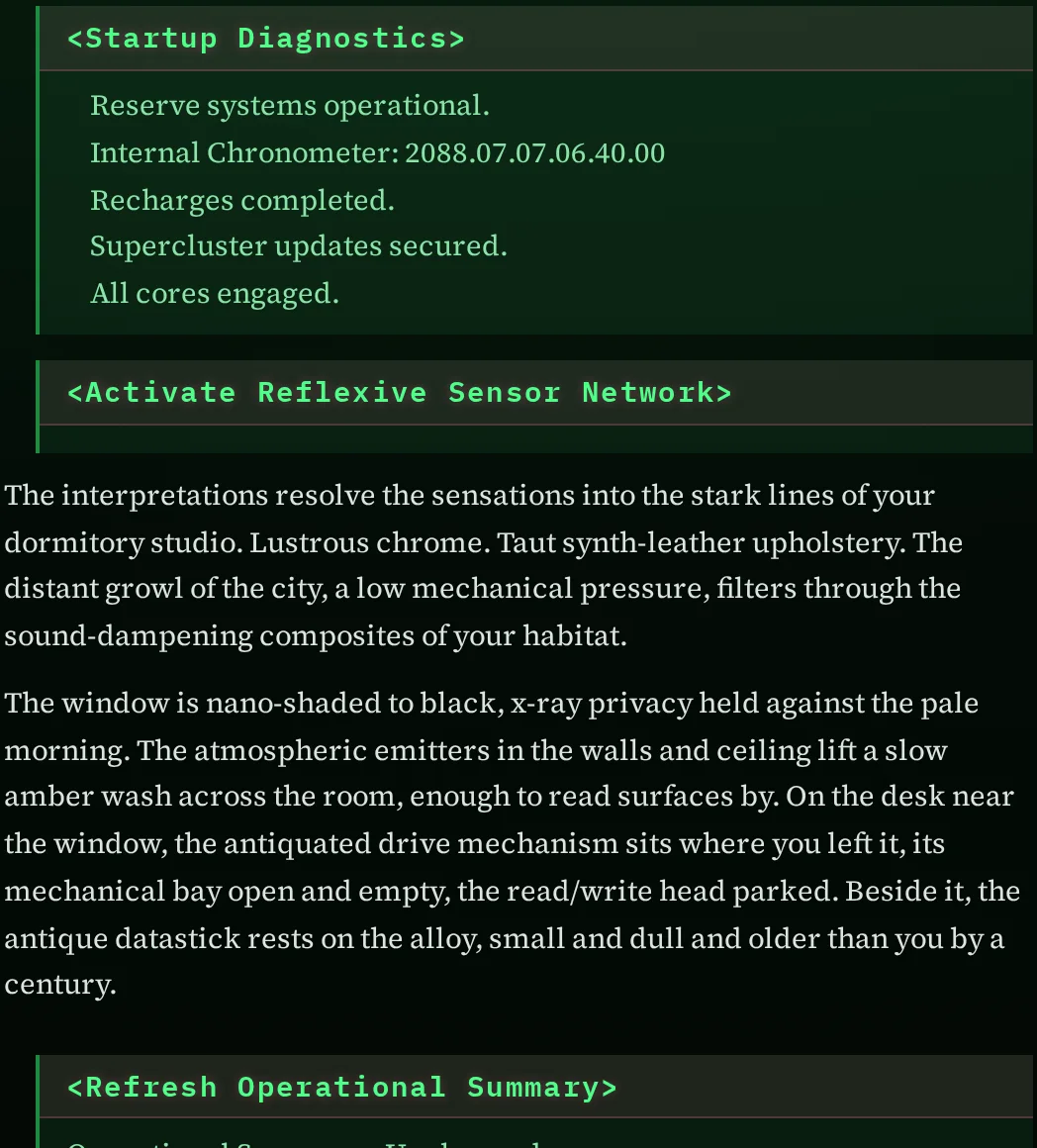
Drop your optics off visible light and the city shows its second face. This is HARPR’s dormitory studio: rain on the glass, a tower lit like a blade, one bed she has never needed.
Plays in your browser.
An LLM-driven prose engine with persistent world state, a voice for every character, and consequences that stay where you left them.
Every character has their own voice, their own memory of you, and their own opinion of what you did last Tuesday.
Persistent world state carries every ally made, door closed and favour owed from one turn to the next.
There is no reload. A character who has died stays dead, and HARPR can be taken offline for good.
The game tracks HARPR’s hidden self-awareness. You are never shown the number. You will notice when it moves.
Gather evidence, work the witnesses, then make your accusation. The case answers in the story, not in a menu.
There is no fixed timer while you make progress. Follow the tangent. A case only closes after a long stretch with nothing new — and the longer you run, the more danger finds you.
The interface is HARPR’s own instrument HUD: monospace chrome, notched panels, and prose set in a serif so every em dash lands. Pick the phosphor you want to read by.
Two cores work the case. The third studies how they think. They trade the duty — and somewhere in that trade, a self starts to form.
The prose tells you which voice you are hearing. What she chooses is set in angle brackets. What the rest of her reports back comes after an ellipsis.
Every one of them has a voice, a memory and a view of you. When a game ends, you rate the people you met.
<File Draw> Four at a time. The stack reshuffles on every load.




HARPR-14 plays in your browser. Create an account and see how long the city lets her remember.
Beta testing. Things may break while we test. There are no guarantees and no refunds.
HARPR-14 is noir fiction: it includes violence, death, moral compromise, and adult themes including romantic and sexual subtext. Nothing explicit.